
"But They Never Hit Me": Rethinking Our Perspectives on Domestic Violence

Photo by Osarugue Igbinoba / Unsplash
When most people hear the words “domestic violence,” they picture something loud and physical. Yelling, name-calling, and hitting. Bruises. Police cars. Neighbors peeking through their blinds at the disruption. And for some survivors, those images are frighteningly accurate.
But many survivors haven't experienced any physical violence at all. Instead, they’ve sat in a haze of confusion and self-doubt. Tip-toed around their words, not sure what to say without offending. Constantly wondered if they really were selfish or “too sensitive”.
Their friends and family dismissed the signs, oblivious to the subtle behaviors happening right in front of them.
These survivors may not have even labeled their experiences as abuse because it wasn’t loud or physical. No one called the police. The neighbors likely had no clue.
Society’s narrow perspective on domestic violence isn't just concerning– it's dangerous.
Psychological and emotional abuse are forms of domestic violence that can be just as damaging as physical violence— sometimes more so due to their insidious nature. These non-physical abuse patterns quietly erode autonomy and confidence, leaving survivors questioning their reality, minimizing their pain, and trapped in relationships that are slowly dismantling their sense of self.
Society's narrow perspective on domestic violence isn't just concerning— it's dangerous. It's time we broaden the narrative beyond dramatic moments and pay attention to the quieter, more underhanded abuses of power.
What Non-Physical Abuse Can Look Like
Petra* thought she was in a relationship with someone who was “just a little insecure.” He'd get hurt when she wanted to spend time with anyone else, saying things like "I guess I'm just not enough for you." He wanted to know who she'd be with, where she was going, what time she'd be home. When they were apart, he’d call and expect her to stay on the phone with him, even if she was at work. And he'd question her about the interactions he overheard, especially those with other males.
When she tried to bring up concerns, he'd flip the script: "I can't believe you'd accuse me of being controlling! I work so hard to keep you safe and happy." She'd end up apologizing, feeling guilty for starting the conversation.
Petra never thought of this as abuse. But she was living under a form of control that was isolating her, twisting her experience of love, and teaching her that her perceptions couldn't be trusted.

Photo by Osarugue Igbinoba / Unsplash
Common Forms of Psychological and Emotional Abuse
Monitoring and Surveillance:
Checking phones, emails, social media accounts, or browsing activity
Using location sharing, shared accounts, smart devices, or other technology for tracking
Monitoring listening activity, playlists, gaming platforms, payment apps, or other digital spaces
Creating new accounts or using unexpected platforms after more obvious channels have been blocked
Showing up unexpectedly or interrogating about daily activities and interactions
Isolation Tactics:
Gradually cutting off access to friends and family using guilt
Creating scheduling conflicts with or drama around social plans
Making loved ones feel unwelcome or moving away from support systems
Financial Control:
Managing all finances and preventing or discouraging work or education
Hiding financial information, creating debt, or stealing money
Using economic dependence as leverage
Emotional Manipulation:
Gaslighting (making you question your memory or perception)
Guilt-tripping and playing victim
Love-bombing and/or withholding affection as punishment
Threats and Intimidation:
Threatening suicide or to leave (and take children)
Threatening to reveal private information
Destroying personal items, aggressive driving, or using size/presence to intimidate
Stalking and harassment through music platforms using playlists, song titles, and uploaded content to communicate after contact has been cut off
Sexual Coercion:
Pressuring for sex or ignoring boundaries
Using guilt or manipulation around intimacy
Threatening infidelity or treating sex as an obligation
Emotional Incest (in family systems):
Parents treating children as emotional partners
Sharing inappropriate details about adult relationships with children
Creating guilt around a child's normal development and independence
These aren't just "red flags" or minor boundary violations—they are abusive behaviors that add up to psychological domestic violence.
Understanding Coercive Control: More Than “Why They Stay”
Coercive control is a concept credited to Dr. Evan Stark and described as "a strategic course of conduct" involving "dominating, exploiting, and degrading a partner and depriving her of basic rights and resources."
Unlike the Power and Control Wheel framework—which can visually imply that physical and sexual violence are the primary forms of abuse while non-physical tactics are subtler methods used to reinforce them—coercive control recognizes that the process of establishing and maintaining power is abuse, in and of itself.
And once power is established through coercive control, neither physical nor sexual violence is needed to reinforce or maintain it.
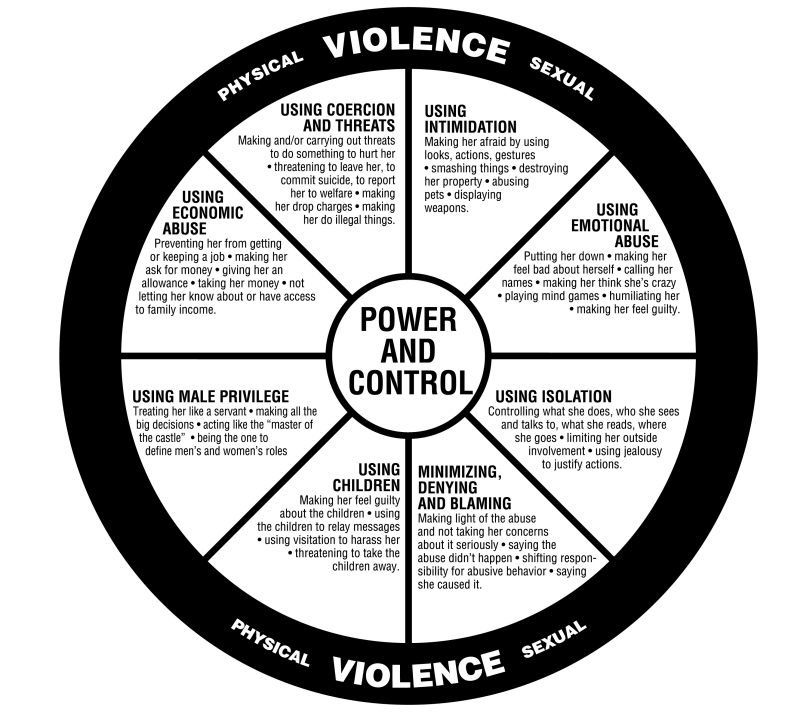
Power and Control Wheel, developed by the Domestic Abuse Intervention Programs (DAIP)
Coercive control creates a climate of fear, hopelessness, and dependence. One of the challenges in recognizing coercive control is that no single act necessarily tells the whole story. A request for a password, a jealous question, a location check, or an unexpected message may look minor when viewed in isolation. What matters is the larger pattern.
Think of it this way: physical violence is an incident or happening. Coercive control is a condition or state of being—it’s the air you're breathing.
In that atmosphere,
having someone monitor your every move might initially feel like concern or attentiveness.
isolating from friends who "don't understand your relationship" might seem like loyalty.
being led to doubt your own perceptions might appear as "helping you see things more clearly."
Manipulation becomes so pervasive that it starts to feel normal, even protective. But beneath seemingly caring behaviors is a calculated effort to subdue. It's no wonder survivors often describe "losing themselves" in such relationships– it's a literal description of what happens under coercive control. This is one reason the concept matters. Instead of asking only, “Was this particular act violent enough to matter?” it invites us to ask, “What is happening to this person’s autonomy over time?”
Why Non-Physical Abuse Goes Unnamed (or Unnoticed)
"I didn't think it was abuse. I was starting to believe that my attitude was the problem, that I was overreacting," Cyrielle* told me during one of our sessions. She recalled pressure to settle in as a stay-at-home mother. Her partner made minimal coparenting efforts and accused her of ungratefulness when she talked about returning to work. With tears in her eyes, she told me of friends who called her “lucky” and said they wished they could be in her shoes.
It took months for Cyrielle to say the word "abuse" in relation to her marriage. She is still working through guilt, shame, and self-doubt– even as she navigates a second marriage with a partner she describes as engaged and supportive.

Photo by Christophe Dusabe / Unsplash
Cyrielle’s experience illustrates why non-physical abuse can be so hard to identify, even as you're living it:
It escalates gradually. By the time the control becomes obvious, it’s also become your normal. You've slowly acclimated to giving up more and more of yourself.
It mimics love. Our culture romanticizes jealousy, possessiveness, and emotional intensity. "He just loves me so much he doesn’t like us being apart" sounds romantic until you realize you can't move without fearing his reaction.
It targets your self-trust. Gaslighting and manipulation specifically undermine your ability to trust your own perceptions. When you constantly question whether you're "too sensitive," “so defensive,” or "always making a big deal out of nothing," you can't rely on your own experience to identify abuse.
It aligns with cultural and gender expectations. Society teaches that women should accommodate, men should provide and protect, and relationships require sacrifice and loyalty “for better or for worse.” These scripts frame controlling behavior as normal and enduring it as admirable.
It's invisible to others. Unlike physical abuse, psychological and emotional abuse leave no visible bruises. Friends and family struggle to see past an abuser’s public charisma, making survivors feel even more isolated and confused.
It affects your thinking. Chronic stress, isolation, and psychological manipulation actually change brain function. Decision-making becomes harder, self-esteem plummets, and the world outside the relationship can start to feel dangerous or impossible to manage.
It's not a "red flag" to you. Emotional incest normalizes unhealthy relationship dynamics and creates a template for continued use in adulthood. Those who experienced it in their families of origin might find "toxic" dynamics familiar and manageable— maybe even comforting— rather than alarming.
Self-Assessment: Questions Beyond "Did They Hit You?"
Instead of focusing so exclusively on physical violence, we need to consider the overall climate of our relationships.
Ask about autonomy and decision-making:
Do you feel free to make basic life decisions?
Can you spend time alone or with others besides your partner without fearing consequences?
Can you express disagreement or different opinions?
Ask about emotional safety:
Do you feel like you're biting your tongue or walking on eggshells?
Are you afraid to be completely honest about your thoughts, preferences, and feelings?
Do conversations often leave you confused about what really happened?
Ask about self-worth and identity:
Do you feel like you've lost parts of yourself in the relationship?
Have you stopped doing things you used to enjoy?
Do you constantly question your partner’s description of your personality and character? Is it misaligned with your self-perception?
Ask about fear and control:
Are you afraid of your partner's reaction to normal daily occurrences?
Do you change your behavior, modify situations, or lower your expectations to avoid conflict?
Does your partner push to know details about everything you do?
Ask about support and isolation:
Do you feel comfortable reaching out to friends and family?
Has your social circle shrunk since this relationship began?
Is there someone you can talk openly to about problems in your relationship?
Ask your loved ones these types of questions. Ask them of your Self, and pay attention to your gut. If several made you uncomfortable or prompted excuses, that's invaluable information.
Getting Help for Non-Physical Domestic Violence

Photo by Marek Studzinski / Unsplash
Abuse does not have to become physical before it becomes serious. You don't need bruises to call it domestic violence. You don't need screaming, police reports, or gripping stories.
If someone is undermining your autonomy, manipulating your reality, isolating you from support, or creating an environment where you can't safely be yourself, that's psychological abuse– a form of domestic violence.
Know these truths:
Your experience matters.
Your feelings are valid.
You have a right to live fully and freely.
Trust your sense that something isn't right. Trust that healthy relationships don't require you to become smaller, quieter, or less yourself. Trust that love doesn't look like control, and protection doesn't feel like fear.
Name what's happening to you; it’s how you begin reclaiming the right to define your own experience. It's how you start reconnecting to who you are when no one is manipulating you.
Reach out for help— whether to a trusted friend, a therapist, or a domestic violence hotline. You don't have to have all the answers or make any immediate decisions. Sometimes the first step is simply speaking your truth to someone who will hear and believe you.
Free, Confidential 24/7 Resources
National Domestic Violence Hotline: 800-799-SAFE (7233)
Deaf Hotline videophone: 855-812-1001, Email: nationaldeafhotline@adwas.org
Text: START to 88788
Online chat: thehotline.org
If you live in Louisiana, Texas, or Washington and want to work together, schedule a free consultation.