
Maybe You Should Try Coming First: Why I Embrace Self-Centeredness & Why You Should, Too
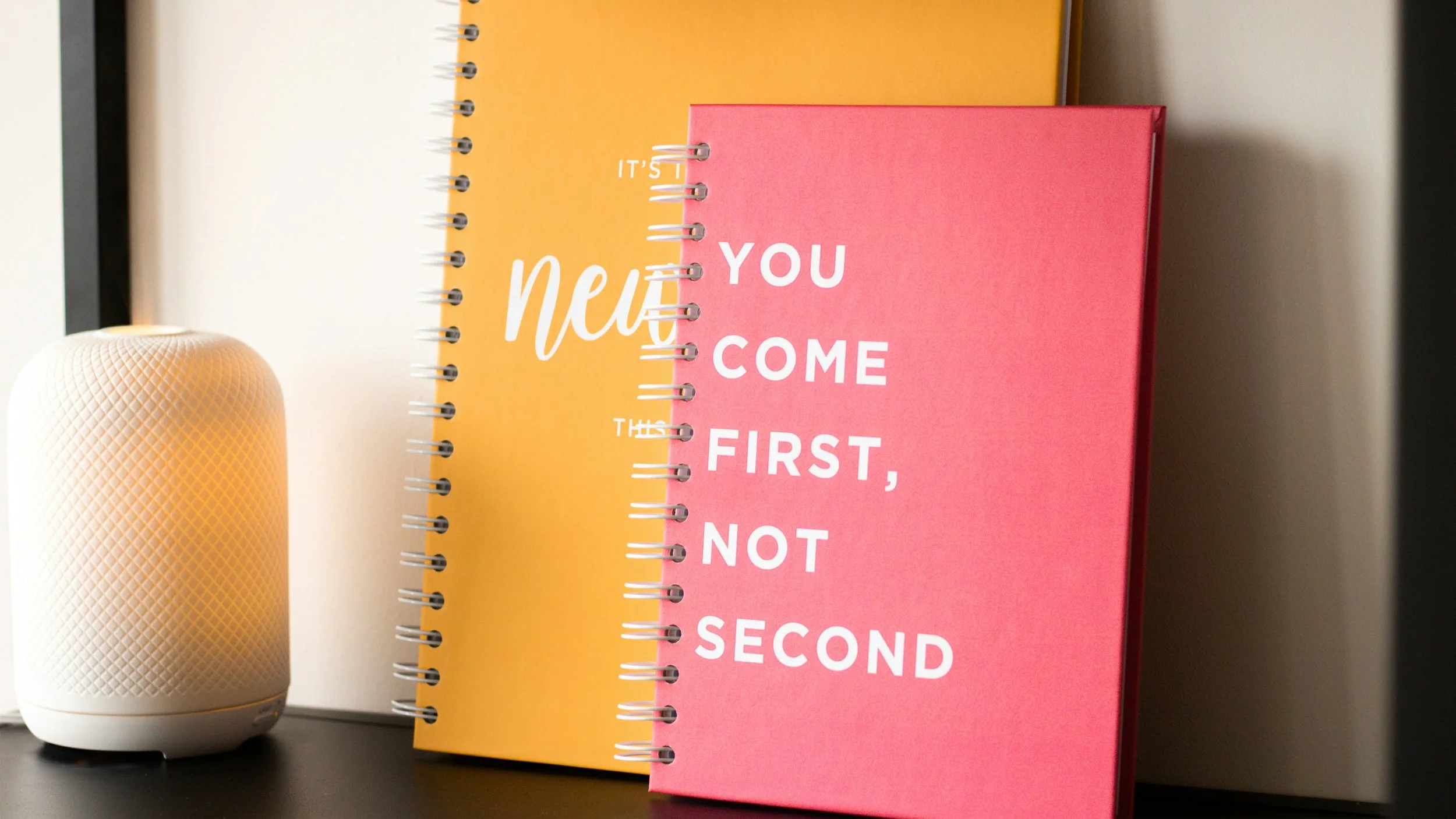
A journal reads “You come first, not second”, giving people permission to prioritize their own needs before meeting others’ needs.
In a society that sets us up to think in dichotomies such as black or white, good or bad, angelic or devilish, being self-centered is usually viewed negatively. But when I really think about the concept, defined by Merriam-Webster as: “(1) independent of outside force or influence; self-sufficient and (2) concerned solely with one’s own desires, needs, or interests”, I find value in being self-centered.
“self-centered: (1) independent of outside force or influence; self-sufficient and (2) concerned solely with one’s own desires, needs, or interests”
Don't most of us know someone who could stand to be at least a bit more independent of outside influence and a bit more concerned with their own interests? Someone we might describe as a pushover, a follower, a people-pleaser? Someone we might see in the mirror a few times a day?
This post is for those people. It discusses a practice of acknowledging and honoring one's own interests in the face of pressure to do otherwise. I'll call this idea “purposeful self-centeredness”, and while I'm still playing with a definition, I'll offer this one for now: (1) nonresponsive to outside force or influence; self-motivated and (2) primarily concerned with one's own desires, needs, or interests.
“purposeful self-centeredness: (1) nonresponsive to outside force or influence; self-motivated and (2) primarily concerned with one’s own desires, needs, or interests”
This practice has helped me connect more deeply with my authentic self, and it continues to help me identify areas where my personal relationships and boundaries require attention.
Are you ready to think about what purposeful self-centeredness might do for you?
Embracing Self-Centeredness

A Black or African-American woman stands in in front of a brick wall, thinking about how to meet her own needs without being selfish or inconsiderate.
Society typically equates self-centeredness with selfishness, but let's stop that now. Look at this definition of selfish: “(1) concerned excessively or exclusively with oneself; seeking or concentrating on one's own advantage, pleasure, or well-being without regard for others and (2) arising from concern with one's own welfare or advantage in disregard of others." Note the phrases "without regard for" and "in disregard of" others.
Self-centeredness does not require excessive or exclusive concern with oneself. However, some concern with oneself is a necessary part of maintaining one's well-being, and a reasonable amount of self-focus does not require a disregard for others. Self-focus can actually improve relationships with others because it supports your mental and emotional wellness. It allows you the clarity to identify and honor your needs and feelings, which increases the likelihood you'll show up as your best self personally and relationally. And with less resentment.
Self-Centeredness for Mental Wellness
Coming from a family that values achievement highly, I have realized that the expectations I have of myself (or that others have of me) are not always reasonable or even meaningful. But that realization doesn't always silence my inner critic.
By centering myself– paying attention to my internal states and ways of thinking– I have become more attuned to the unique ways in which I do life, recognizing and accepting more of my limitations and personal quirks. I now factor them into my daily planning and goal-setting.
On days when I'm more energetic or focused, I prioritize more demanding or complicated tasks. On days when I'm tired or distracted, I take it easier, maybe reviewing and updating my calendar and deadlines, breaking complicated tasks into more manageable steps, or doing a more enjoyable task that requires less external motivation. This flexible response to fluctuations in productivity allows me to pivot when appropriate and to wrap up more days feeling a level of satisfaction with what I accomplished.
Completing tasks and meeting goals feels great, but they are not sustainable without intentional self-care. I use the insights I've gained about my unique approach to life to inform the ways I choose to take care of myself. For example, I've gotten better at knowing when difficult emotions are tempting me to skip a much-needed night out versus when I'm choosing a night in because I need to recover from difficult experiences.
What might you discover if you choose to purposefully center yourself?
A neon sign reads, “Darling, you’re different,” acknowledging that diversity is normal and to be honored.
What are your distinctive approaches to life? What characteristics might you factor into your planning and goal-setting? Developing personalized, resonant goals means you are more likely to stay committed to your plans. You are less likely to succumb to the weight of external pressures from society, family, and culture– all of which can (sometimes unknowingly) encourage codependent patterns.
When you take action based on your values, strengths, needs, and desires, it becomes easier to temper distractions and oppositions that could derail your progress. You can carve out space and time for working toward your goals without feeling guilty for deprioritizing competing tasks and obligatory engagements.
And how will you take care of yourself? Self-care is not just a buzzword; it’s an essential component of a thriving life. When you take good care of yourself, you’re better able to access internal guideposts and motivators, such as your personal morals and values, and you're better able to keep momentum, leading to more consistency and balance overall.
The Self-Centered Planner Template
If you've read this far, you're probably open to reconsidering the concept of self-centeredness. I’d like to share with you a planner template that I’ve been using. The template includes daily, weekly, and monthly planning pages and a master task list. I started with a Canva design by Nine Stars that I personalized to embrace self-focus with a spirit of positivity; I’m calling it The Self-Centered Planner.
At the top of the daily page, I’ve included two prompts: “Today is” and “I am”. I usually write in the date and then reflect on an affirmation, an intention, or simply acknowledge where I’m starting the day mentally. There is also space for a “Note to Self” — I like to write something that reinforces my “I am” statement or reminds me to be compassionate toward myself. You could also use this space to encourage moments of self-care, such as practicing deep breathing or standing up to stretch.
I chose to include a section labeled “My Money”, as I am currently working on my relationship with money and its energy. I use this section to track a daily account balance. That might not be a need for you right now, so edit to the template to center whatever is your current need. Maybe you want to focus on water intake or tracking a habit such as meditation.
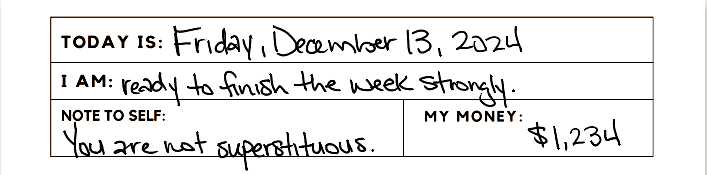
An excerpt from The Self-Centered Planner Template by Shameka Mitchell, LCSW/LICSW of The Chrysalis Center, LLC featuring an affirmation and mindfulness prompt.
The center section, “My Plans”, is where I create a visual layout of my day. I chose the word “plans” intentionally rather than a word like “schedule” or “agenda” because I liked the following definitions provided by a quick look-up as I was personalizing the template:
“plan: (1) a detailed proposal for doing or achieving something, (2) an intention or decision about what one is going to do.”
I appreciate words like “proposal”, “intention”, and “decision” because they capture the motivation and desire to do a thing while making room for the possibilities of rejection, redirection, and reconsideration. For me, “schedule” and “agenda” feel more formal and rigid. I even avoided "day" because I don’t want to feed an all-or-nothing mentality where having a segment of the day go off-schedule could negate the rest of the day. If you prefer the structure and drive of words like “schedule”, “agenda”, “day”, or whatever you come up with, edit away!
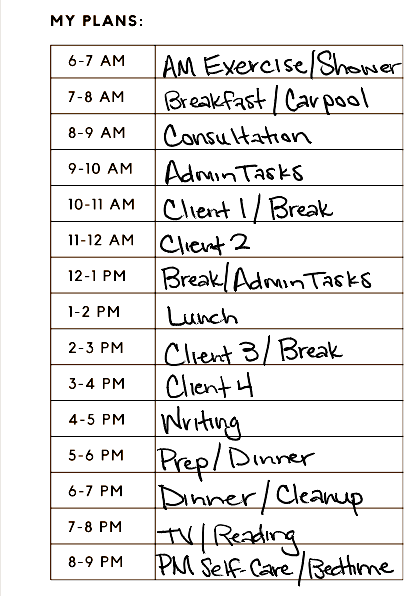
A daily planning excerpt from The Self-Centered Planner Template by Shameka Mitchell, LCSW/LICSW of The Chrysalis Center, LLC
I chose to start my day at 6 AM and end it at 9 PM, on the hours. Of course, you can personalize this to suit your wakeup and bedtimes or a preference to schedule on the quarter- or half-hour. I've found that accounting for each hour of my day helps me know where to pick up when I do get off-schedule. I've also been able to see more accurately how I waste time because I’ve been noting what I did instead of what I planned to do. Revisiting my plans several times throughout the day provides interesting insights, which I can use to pivot as the day evolves, and it also informs future planning.
At the bottom of the page, a “Today I Learned” section prompts a final reflection on insights, useful lessons, or other takeaways from the day while a “Tomorrow I Might” section encourages immediate application of those learnings.

An excerpt from The Self-Centered Planner Template by Shameka Mitchell, LCSW/LICSW of The Chrysalis Center, LLC featuring self-reflection and future-planning or goal-setting.
During the reflection, you might ask yourself some of the following questions:
What did I say yes to today that I should have declined? What did I say yes to today that was a great idea?
What did I say no to that I now regret? What did I say no to that allowed me to keep momentum?
What was a key realization in accomplishing a particular task? Did I miss a prerequisite step in accomplishing a particular task?
What was I doing / with whom was I interacting before my day went off-track? What was I doing / with whom was I interacting before I felt inspired?
What fears did I overcome today, and how might I build on that tomorrow? What fears paralyzed me today, and how might I challenge them tomorrow?
With your answers, you can assess how well you did or did not center and honor yourself, and you can make adjustments as you deem necessary.
Self-Centered Planning for Enhancing Relationships
Relationships need boundaries. Healthy personal boundaries are a prerequisite for healthy relational boundaries. In a culture that frowns on self-centeredness, I find it no surprise that boundaries, too, often get the side eye. For example, clients often share with me how they’ve been accused of “acting ugly” or being selfish for saying no to something like driving a family member around to run errands. When these clients gave in to pressure— because they did not want to be thought of as ugly or selfish— they found themselves feeling frustrated over tasks they’d been unable to complete for themselves as a consequence of dishonoring their boundaries.
Rather than seeing them as offensive, we can think of boundaries as an emotional filtration system for the external pressures that pollute our inner worlds. By defining what can and cannot get through, we cultivate a mindset that supports us in moving toward our most authentic desires. Healthy, reciprocal relationships welcome such a mindset.
My clients who were so afraid of being selfish might have been able to help their family members without sacrificing their own plans if they had set boundaries around their time by planning from a space of purposeful self-centeredness– prioritizing whatever was most important for them to accomplish that day, ahead of their family members' non-essential requests. This is why I chose to include a “Today’s One Thing” section: because there are days when I don’t have the resources for everything I’d ideally like to accomplish, but I know I can end the day feeling satisfied if I accomplish what I consider to be the one big thing for the day.
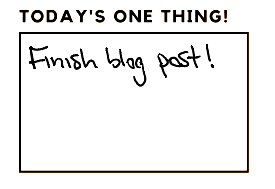
An excerpt from The Self-Centered Planner Template by Shameka Mitchell, LCSW/LICSW of The Chrysalis Center, LLC identifying a task of the day, one big thing, or a big rock, supporting prioritization in planning.
So, one client, who did not have time left to clean out her storage space after driving others around, could have made doing the favor contingent upon completing her own task first. And if she had completed the cleaning task first, she might even have noted some things she needed to pick up for herself while they were out, making the errand run mutually beneficial.
Or if she acknowledged while planning her day that she simply could not accomplish her one big thing and drive others to run errands, she could have offered to do the favor on a day that would work better for her availability. Saying “not now” could have allowed my client to honor both her desire to complete an important personal task and her desire to be helpful and unselfish.
A much less popular option would have been to decline doing the favor altogether. Saying “no”, while sometimes hard, is sometimes the better option.
Regardless of how she'd have chosen to respond to her family members' request, purposefully self-centered planning could have supported my client in being honest with herself and her loved ones about her capacity. I find it ironic society presents the narrative that self-centeredness should be tied to guilt and shame; we might actually discover that embracing the concept elevates our relational experiences by releasing us from obligation to anything other than becoming our best selves.
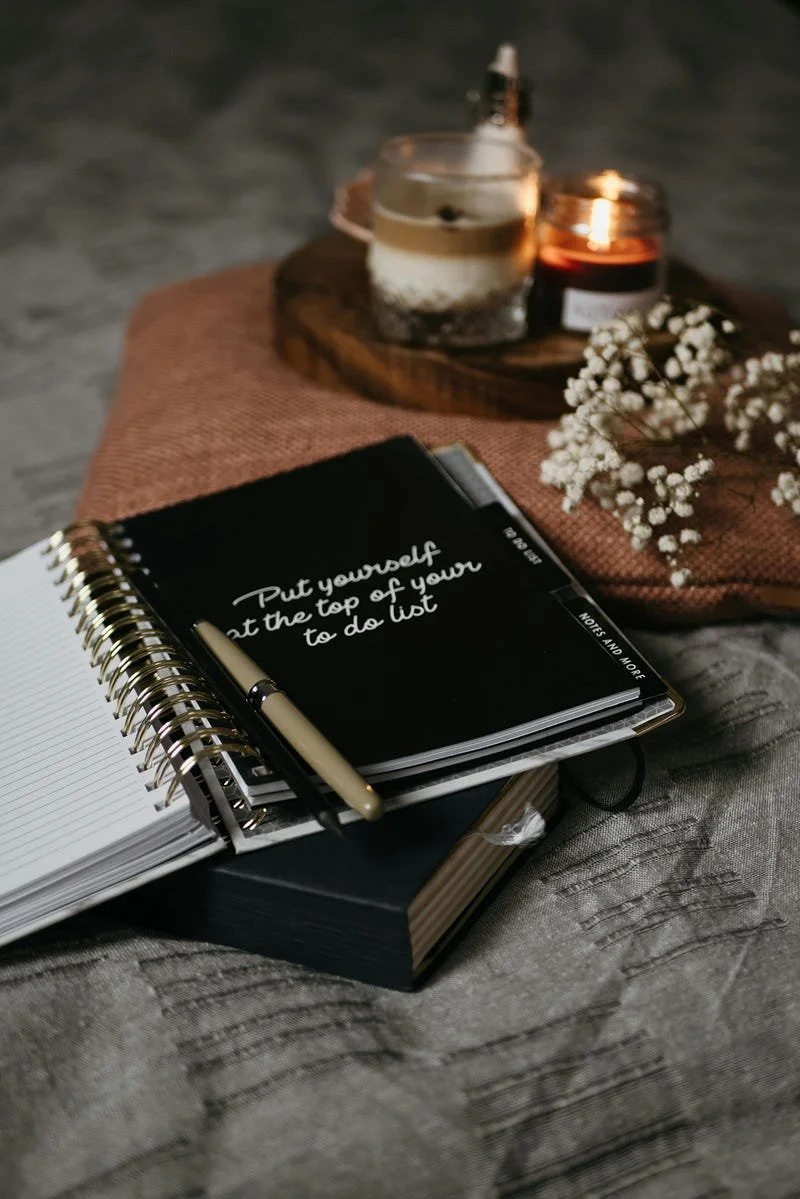
A journal page reads “Put yourself at the top of your to-do list”, encouraging purposeful self-centeredness that respects personal boundaries.
Keeping Up with All the Things
The daily page template includes lists for things to do and ideas to explore. I list to-dos I’d be happy to accomplish during the day but that could roll over to a following day, if necessary, because they are not the one big thing. I list any ideas or concepts that seemed interesting to me that day and that I don’t want to forget.
I pay attention to how many times a task or idea rolls over because that might indicate it is: (1) not that important, (2) not properly defined, (3) something to which I’m feeling major resistance, (4) impacted by some other yet-to-be-discovered block, (5) possibly all of the above.
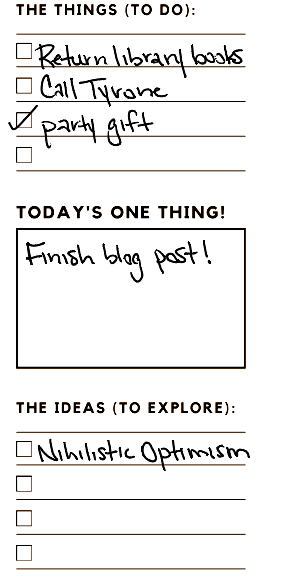
An excerpt from The Self-Centered Planner Template by Shameka Mitchell, LCSW/LICSW of The Chrysalis Center, LLC featuring a daily to-do list and parking lot for ideas to explore.
The monthly page includes its own lists for to-dos and ideas; I need a place to park random thoughts that come to me at random times. If I remember a task that needs to be handled in the current month or an idea I’d like to look into sooner rather than later, I’ll write it here so that I can assign it to a day, which I will later plan in more detail.
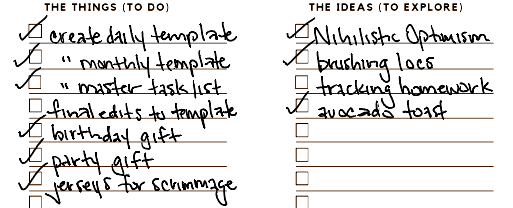
An excerpt from The Self-Centered Planner Template by Shameka Mitchell, LCSW/LICSW of The Chrysalis Center, LLC featuring a monthly to-do list and parking lot for ideas to explore.
I had a client describe herself as “neurospicy”. If I’m being honest, my own spiciness is likely why the template includes a third page dedicated to “All the Things (To-Do) & Ideas (To Explore)” — I have a lot of random thoughts to park. If you aren’t as randomly spicy as I am, you might not need this page at all, or you can edit it to suit your own level of spice. I like to track the dates of things I add to this list plus a goal date because, as I mentioned earlier, if a task or idea continues to roll over without any consistent attention, maybe it doesn't need my energy at this time.
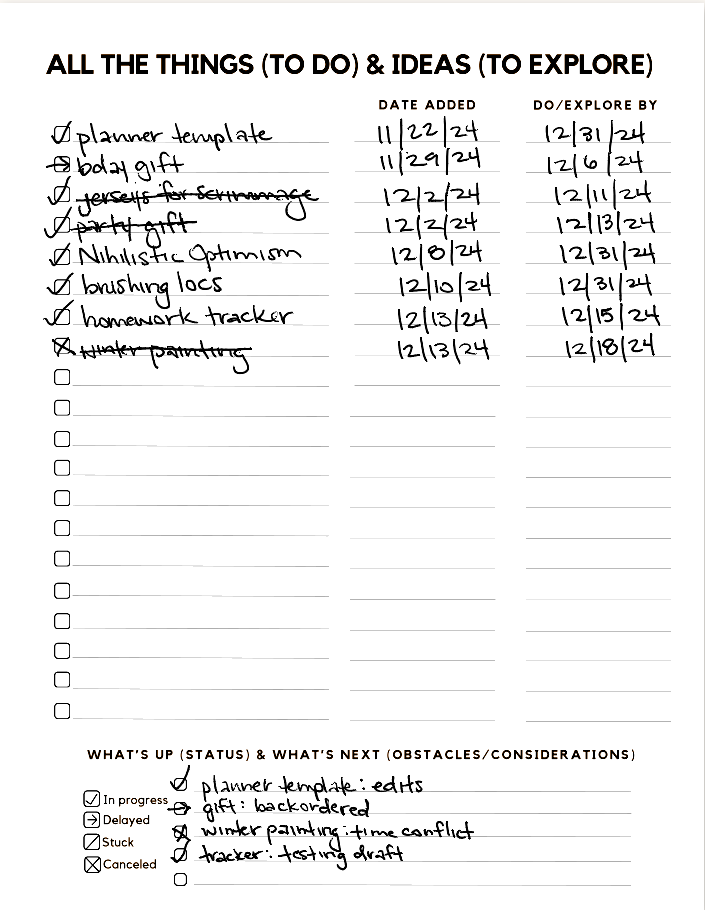
An excerpt from The Self-Centered Planner Template by Shameka Mitchell, LCSW/LICSW of The Chrysalis Center, LLC featuring an expanded to-do list and parking lot for ideas to explore.
Learning to Leverage Daily + Monthly Planning
In contrast to what I wrote above, I used to find planning by the hour tedious and unnecessary for the ways in which my life was set up. I knew I’d go to work each day, where planning my time usually didn’t matter– the chaos of the job would take the wheel more quickly than even Jesus could.
After work, I knew I’d go home and do whatever I still had capacity to do: usually pull together a dinner menu on the drive home, cook dinner and wrangle children, eat dinner and/or wrangle children, bathe children and/or myself, go to bed, and wake up with the same sense of disempowerment that made daily planning feel pointless.
Weekends would be very similar minus work, plus a breakfast and lunch menu, plus church. I was moving through life by society’s definition of selflessness, allowing my boss’s/children’s/husband’s/church’s/mother’s/friend’s or community’s needs and expectations to determine how I spent my time. I had no awareness of my right to manage and protect my own time.

A Black or African-American woman with eight (8) fingers pointing at her, competing for her attention and energy, while she covers her face with her palms because she is overwhelmed, overstimulated, and confused.
Then, life shifted. We had more children, I ventured into mompreneurship, marital strife continued to recycle, and a list of unmet personal needs and goals began screaming for my attention. I started to notice who and what were getting that attention instead, and I wanted to make some changes. Daily planning has been helping me narrow in on how I’m using each hour of the time that I am grateful to now more fully control. But I don’t want to lose sight of the forest for the trees.
So, I chose to continue using a monthly page to zoom out and strategically align daily planning with my monthly goal, which I’ve labeled “This Month’s One Thing”. I've observed my procrastinator self enough to know that she stops restraining my productive self within a few weeks of a hard deadline. So, I work backwards from the deadline on the monthly calendar to designate which days I will spend working toward meeting it, and than I zoom back in to plan the specifics of those days.
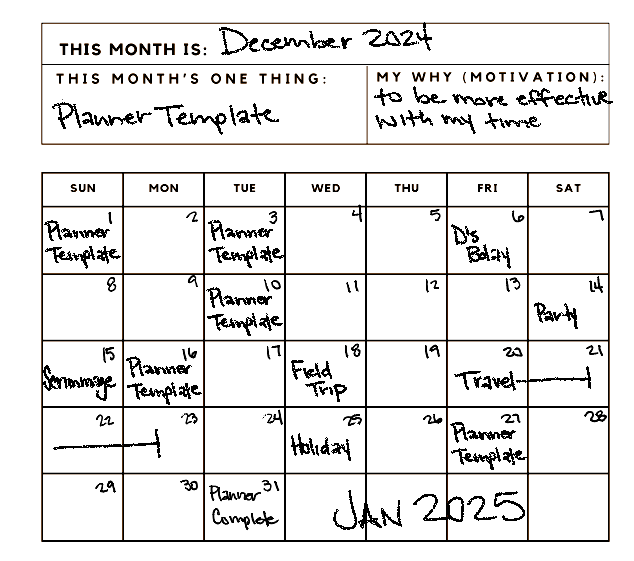
An excerpt from The Self-Centered Planner Template by Shameka Mitchell, LCSW/LICSW of The Chrysalis Center, LLC featuring a monthly calendar, highlighting motivation and a priority for the month.
The monthly overview is also useful in balancing social and leisure time with productivity. Noting all of your commitments for the month lets you see their proximity to one other and to important deadlines so that you can be more aware of any potential impact. For example, our family was invited to a holiday party ending at 830 PM, which sounded reasonable until I pulled out the planner and saw we had to start a 630 AM roadtrip the next morning. That made my decision to decline swift and firm, partly because I also saw what was on the calendar in the coming days, so I did not feel guilt over the kids missing that one event. On the other hand, seeing a month with nothing fun or leisurely planned might encourage you to prioritize social commitments to maintain balance.
Lastly, I included a section, “My Why”, to tap into my motivation for keeping focus on the month’s one thing, and I will use changes in my level of motivation to revisit whether or not the why is still relevant for me.
Channeling Self-Centeredness into Personal Growth

A Black or African-American woman who has learned to put herself first and be self-centered in a purposeful and healthy way smiles, as she feels centered and relieved from the weight of people-pleasing.
Daily planning and reflection from a place of purposeful self-centeredness has grown me both personally and professionally. I have more self-awareness, more self-acceptance, and more self-compassion. I'm taking meaningful steps toward crafting a fulfilling life that feels aligned with who I am at my core.
This is all a result of paying attention to my inner experience, accepting it as valid and meaningful — and planning my life around it. Even when I don’t fully understand my thoughts and feelings, I can sit with them for whatever insights they'll yield. Overall, I am witnessing my Self showing up more authentically for myself, and therefore, for others, and I have been surprised and encouraged by their responses.
One lovely response has been seeing other people find permission and courage to embrace purposeful self-centeredness, too...or at least to consider it. And that’s why I believe you should try it, too!
Need a bit more guidance implementing something like this?
Schedule a free consultation or a paid Clarity Session to discuss fit and next steps.